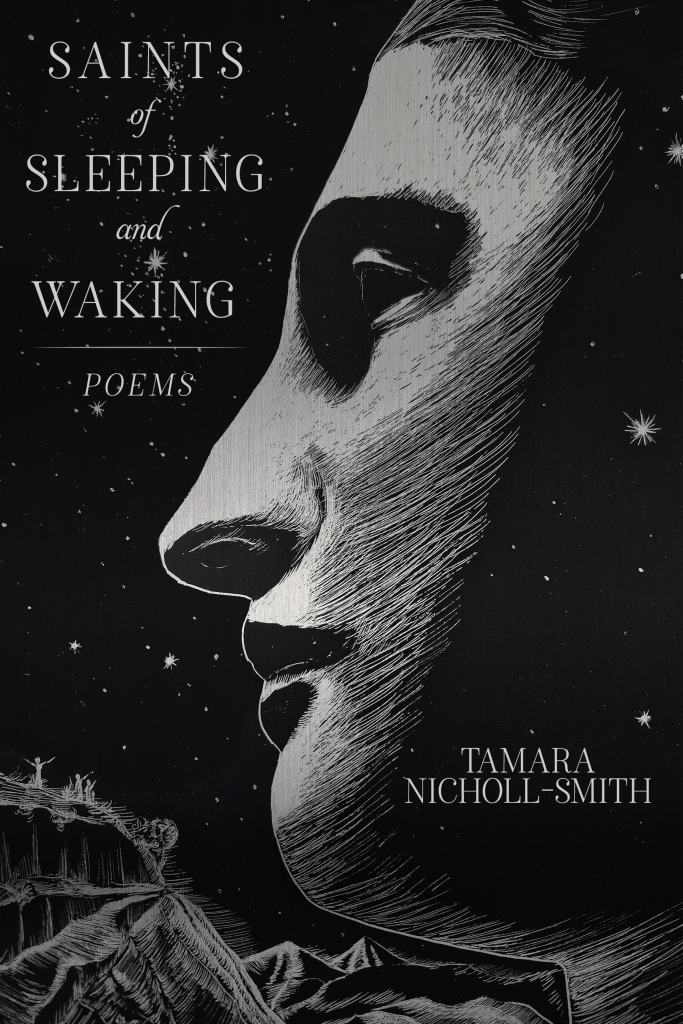
Debut poetry collection
Wiseblood Books
February 23, 2027
Paperback and hardcover available
Hardcover available for pre-order; availability after publication is not guaranteed.
Advance Praise for Saints of Sleeping and Waking
In Saints of Sleeping and Waking, it is almost as if the griefs and losses of human experience, grown intimate through long acquaintance, have taken on the shape of a long-expected visitor, if not quite a friend. To immerse oneself in this collection of poems—watchful, sensorially rich, attentive to form, and by turns physical and metaphysical—is to come to see anew that while sorrows do not cease to be sorrows, they can be transfigured. As the prophet says, for those who grieve: beauty for ashes. With delicate resonances of Augustine, Dante, Hopkins, T. S. Eliot, Geoffrey Hill, W. H. Auden, Friedrich Hölderlin, and Allen Ginsberg, Tamara Nicholl-Smith’s verse demonstrates that all that is lost, late, forgotten, or folded can somehow be redeemed in the graces of poetic speech and in the promise of the resurrection.
—Jennifer Newsome Martin, John J. Cavanaugh Associate Professor of the Humanities, University of Notre Dame
Just when you think today’s poetry has been largely reduced to “a homogenous set of pretentious trends,” as one observer put it, along comes Tamara Nicholl-Smith’s vibrant collection, Saints of Sleeping and Waking. It’s a virtuoso performance of music and metaphor, of closed and open form that draws from the great traditions of Western poetry, from the Horatian ode to Hopkins’s curtal sonnet to imaginative uses of free verse. But Nicholl-Smith’s mastery of these artistic instruments is secondary to her sacramental purpose, one forged from searing loss and the discovery through faith of “small things that move mightily prevailing winds.” These poems revive poetry’s true and vital power as they summon “the light that holds us.”
—Suzanne Underwood Rhodes, Arkansas Poet Laureate and author of The Perfume of Pain
From epiphanies to illnesses, from losses and bereavements to the anatomy of ordinary happiness, Tamara Nicholl-Smith will grab your heart and carry it through the rich journey that is this first collection. There’s nothing distant about this poetry. Whether we are considering Augustine, walking through Krakow, or bearing witness to the poet’s moving relationship with her elderly mother, Nicholl-Smith enlightens us, time and time again, with her wit, and freshness of vision. Whether in free-verse, villanelle, or curtal sonnet, her command of the poetic line is masterful. But this is a book for anyone—poetry aficionado or not. It’s a book which makes the reader nod (and, yes, cry) with its acute and luminous insights about our lives.
—Sally Read, editor of 100 Great Catholic Poems
At the midpoint of Tamara Nicholl-Smith’s book of poems, she addresses the Latin poet Horace, that master of rhetoric and measured speech. Horace is indeed her proper predecessor and interlocutor, for, in Nicholl-Smith’s poems, we encounter not text, not language, but human speech—the rhetoric of public and private occasions, of lyric and elegy, that reminds us the art of poetry is precisely the art of significant sound beautifully spoken. Time and again, the poems in this book fly off the page and become music, become the purest and most stirring of rhetoric. As Horace himself would have put it, they do not sink, but rise.
—James Matthew Wilson, author of Saint Thomas and the Forbidden Birds
Rhapsodic and chatty, fractured, faithful, the poems in Tamara Nicholl-Smith’s ample and companionable debut seek and find the real presence of the Gospel in the daily news all around the world, from the Valley of Fires to the Acropolis, New Jersey to Jerusalem. Cosmopolitanly intimate and as warmly inhabited as the rainy-day blues, this collection gathers snapshots of a pilgrim spirit searching the tenebrous realms of guilt and loss for revelatory illumination. The best poems in Saints of Sleeping and Waking (e.g. “Letter to Horace,” “Disquiet,” and “Three Nails,” among others) discover an exuberant music, both earthy and intelligent, moody and meditative, and distinctive as great jazz.
—Ryan Wilson, author of In Ghostlight
Average humans spend one-third of our lives sleeping. This means if you are 75 years old, you’ve slept 25 years! Traditionally, we divide our time between sleeping time and waking time. Pull back the cover of the magical book you are now holding in your hand. That cover is a portal to a world where time runs differently!
Saints of Sleeping and Waking will lengthen your life by 25 yearsbecause in the world of these poems, there is no boundary between sleeping and waking time.
Your newfound friend, the somnambulist, will tell you:
In sleep, I am not still
I wander in the dark . . .
In the day, . . . I feel heavy with sleep
. . . A voice tells me . . . to wait, patiently
in the darkening fold.
Pulling back our book covers again and again, we readers will hear new voices. New voices that might bring additional and unexpected depth into our own lives.
—Andre De Korvin, author of The Four Hard Edges of War
In Tamara Nicholl-Smith’s poems, she takes us by the hand and shows us her world and her faith. She evokes images from her “mother curled in the hospital bed like a fetus in a sonogram,” to prayers, “stellar light, your head, haloed, crowned with stars.” Her poems float like hymns—come sing and heal with her.
—Gary Glazner, founder of the Alzheimer’s Poetry Project
Advance Review Copies
Reviewers, literary editors, and journalists interested in reviewing Saints of Sleeping and Waking are invited to request an advance review copy through Wiseblood Books.


